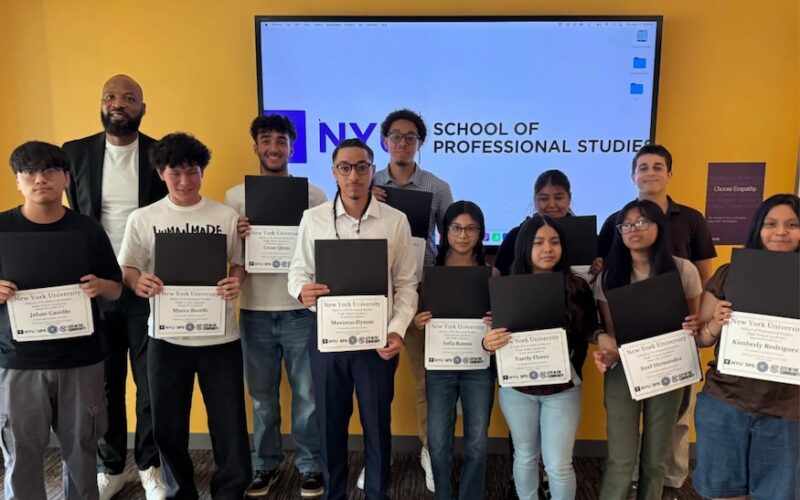
During the summer, City in the Community (CITC)—New York City FC’s social initiative—joined forces with New York University (NYU) to deliver a complimentary, three-week Artificial Intelligence (AI) course for youth ages 16-23. The program, held at NYU, was led by faculty from NYU’s School of Professional Studies and the Tisch Institute for Global Sport, representing the fourth year of partnership aimed at creating educational and career access for high school students.
Participants from CITC’s various weekend programs, notably Saturday Night Lights, delved into AI applications in sports, community, and business. Working in teams, students conceived AI-based ideas to foster innovation, access, and inclusiveness in their local areas.
Experiential Learning and Support
With mentorship from NYU Adjunct Professor Herbert Hill and CITC’s Jack Jacobs and Joe Sullivan, students developed hands-on proficiency in sports technology, AI, machine learning, and critical thinking. The course blended academic learning with CITC’s mission to uplift youth via sport, technology, and education.
“In big organizations, efforts like this are often only symbolic, but New York City FC was genuinely committed throughout,” stated Herbert Hill. “Their ongoing involvement encouraged our students, making them feel significant and motivated, and demonstrating AI’s relevance in daily life and communities as well as sports.”
Advancing STEM Pathways
This program is part of CITC’s broader work to build equitable access to STEM fields for young people from diverse backgrounds, and to merge sport and technology for greater health and opportunity.
“We’re grateful to NYU and the Department of Youth & Community Development for ongoing collaboration,” said Bailee Eaglin, Director of Community Development for City in the Community and New York City FC. “The impact is clear when young people can interact with new tech and imagine what’s possible for their lives. We look forward to deepening and expanding this work across our city and team.”
Program graduates concluded by presenting their projects to NYU faculty, CITC guides, and community partners—demonstrating solutions that will influence upcoming programs and ignite future innovation in sports and tech.